Why Your Table Tennis Serve Loses Spin When Your Hands Are Cold
Quick Answer: Three things degrade at once. Your rubber gets harder and less tacky in the cold, which reduces grip on the ball. Your hand and forearm lose fine motor control and speed, and spin depends on rapid wrist acceleration more than on force. The ball itself is stiffer and rebounds differently. The technique is unchanged; the equipment and the hand executing it are both operating outside their usual range.
This is why the first twenty minutes in a cold hall in October feel like someone swapped your bat.
All three are partially addressable, and one of them is nearly free.

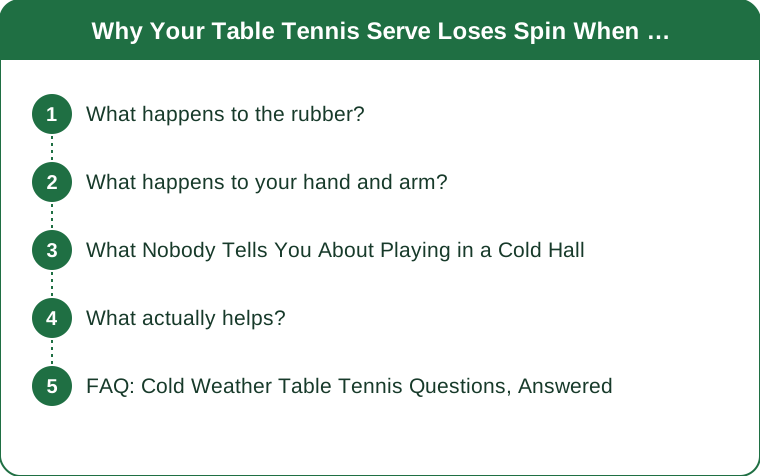
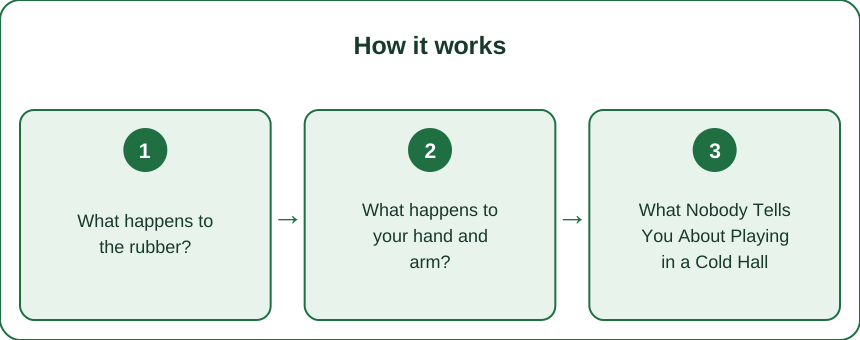
What happens to the rubber?
Rubber hardens as temperature drops. Table tennis rubbers, particularly the topsheet and the sponge underneath, are temperature sensitive. Cooler rubber is stiffer, which changes both dwell time and how much the ball sinks into the sponge.
Less dwell time means less spin. Spin is generated during the brief period the ball is in contact with the rubber. A harder, less compliant surface reduces that contact time, and less contact means less rotation imparted.
Tackiness reduces in the cold. Tacky topsheets rely on surface adhesion, which is temperature dependent. A rubber that grips well at 70F noticeably underperforms at 55F.
The sponge is the bigger factor for most modern rubbers. Sponge hardness changes significantly with temperature, and a sponge that was tuned to a certain feel becomes a different rubber in a cold hall.
Speed changes too, not just spin. A colder rubber typically feels slower and duller, which is why players describe the bat as feeling dead.
And the effect is not uniform across rubbers. Softer sponges and tacky Chinese-style rubbers tend to be more temperature sensitive than harder European-style ones, which is worth knowing before blaming yourself entirely.
What happens to your hand and arm?
Fine motor control declines with hand temperature. Manual dexterity is measurably reduced when the hand cools, and serving is one of the most dexterity-dependent actions in the sport.
Contraction speed drops. Muscle contraction and relaxation both slow at lower tissue temperature, and spin generation depends on how fast the wrist can accelerate through contact, not on how strongly.
Grip tension increases. Cold hands grip harder, and a tight grip is one of the most reliable ways to kill wrist snap. The bat needs to be held loosely for a spinny serve.
Proprioception is reduced. Your sense of where your hand and bat are in space is less precise when cold, which affects contact point accuracy, and serving depends heavily on hitting a very specific part of the ball.
The forearm matters as much as the hand. The muscles producing wrist rotation are in the forearm, and they are usually less well covered and less warmed up than the shoulder.
And your warm-up is probably too short. Players warm up by knocking, which warms the shoulder and the legs and does relatively little for the specific wrist and finger action a serve requires.

What Nobody Tells You About Playing in a Cold Hall
The ball changes too. Plastic balls are stiffer in cold air, which affects both bounce and how the ball interacts with the rubber. The sound changes as well, and contact sound is a genuine timing cue.
Your opponent has exactly the same problem. Everyone’s serves are less spinny, which means everyone’s returns are also being made against less spin. The adjustment is mutual, and recognising that prevents overcorrecting.
The first twenty minutes are the worst. Both the rubber and your hand warm up during play, so a match that starts badly frequently improves without any technical change.
Keeping the bat warm is the easiest fix. A bat left on a cold table between games is colder than one kept in a case or under your arm, and the difference is noticeable.
Rubber cleaning matters more in autumn. Dust and reduced humidity together mean a rubber loses grip faster, and a clean rubber performs substantially better than a dusty one, especially a tacky one.
Dry air reduces grip on the handle too. Autumn indoor air is drier, which changes how the handle feels and encourages a tighter grip.
And the effect is largest on the serves you rely on most. Heavy underspin and sidespin serves are the most contact-dependent, so they degrade first, while flatter, faster serves are barely affected.
What actually helps?
Keep the bat off cold surfaces. In its case, under your arm, or in a pocket between games. This is free and it makes a real difference.
Warm up your hands and forearms specifically. Open and close the hands hard, wrist circles both directions, and shadow-serve twenty times before you play. Knocking does not do this.
Loosen your grip deliberately. Consciously relaxing the fingers is the single most effective in-match adjustment, because cold-induced grip tension is what removes the wrist snap.
Serve short and low rather than heavy, early on. Placement is much less temperature sensitive than spin, so lean on it while the equipment warms up.
Clean the rubber before playing, every time. More important in autumn than in summer, and it takes fifteen seconds.
Wear a long-sleeve layer over the forearms during warm-up and take it off once you are properly warm. The forearm is the muscle group doing the work and the one most often left cold.
Give yourself twenty minutes before judging anything. Both you and the rubber are different by then, and technical changes made in the first ten minutes are usually corrections to a temporary problem.
And consider a harder, less temperature-sensitive rubber for winter play if you regularly play in cold halls. It is a real equipment consideration rather than an excuse.
FAQ: Cold Weather Table Tennis Questions, Answered
Does temperature really affect rubber that much?
Yes. Both topsheet tackiness and sponge hardness are temperature dependent, and both affect how much spin you can generate.
Should I change rubber for winter?
If you regularly play in cold halls, a harder, less temperature-sensitive rubber is a reasonable choice. Tacky rubbers are the most affected.
Why does my serve come back so much easier in the cold?
Because it has less spin on it than usual, so your opponent is returning a different ball than they would in summer.
How long does it take to warm up properly?
About twenty minutes of play for both hand and rubber. Shadow serving and hand warming before you start shortens it considerably.
Does grip pressure really matter that much?
Yes. A tight grip removes wrist snap, and spin depends on wrist acceleration far more than on force.
Is the ball affected too?
Yes. Cold plastic balls are stiffer, bounce slightly differently and sound duller, which affects your timing cues as well as the physics.
TL;DR:
- Cold rubber is harder and less tacky, which reduces dwell time and therefore spin.
- Cold hands lose fine motor control and contraction speed, and spin needs wrist acceleration.
- Cold-induced grip tension is the largest single technique cost, and it is free to fix.
- The ball is stiffer too, changing bounce and the contact sound you time from.
- Keep the bat in a case, warm the forearms, clean the rubber, and shadow-serve first.
- Lean on placement rather than spin for the first twenty minutes.
Your serve is fine. Everything it depends on is cold.
Keep Reading
This article is for general informational and styling purposes only. Fit, sizing, and product availability may vary.