Why Your Backhand Block Fails Against Heavy Topspin
Quick Answer: A topspin ball arrives with the top of the ball rotating forward, and when it hits your rubber that rotation grips and kicks the ball upward off your bat. A block angle that works against a flat drive sends a heavy loop long every time. The fix is to close the bat face more - tilt the top of the bat forward over the ball - and to absorb rather than push. How much you close depends on how much spin is on the ball, which is why reading the opponent’s swing matters more than reacting to the ball’s speed.
Your block is not too soft. It is too open.

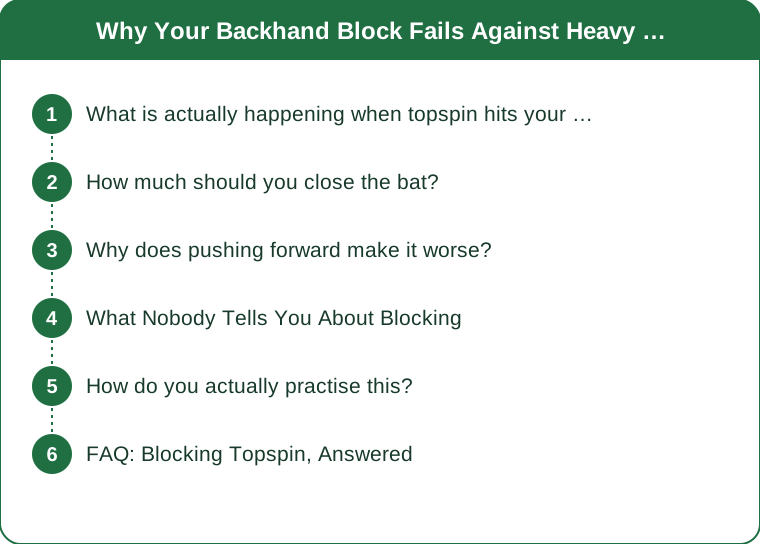
What is actually happening when topspin hits your bat?
The ball is rotating forward at the top, and on contact that rotation grips the rubber surface and converts into upward force.
The heavier the spin, the more the ball kicks up, independent of how fast the ball is travelling - a slow, heavy loop can be harder to block than a fast flat drive.
A neutral or open bat face adds even more upward direction, which is why the ball sails long rather than landing short.
Grippy inverted rubber makes the effect stronger. The same block with short pips or anti-spin behaves completely differently, which is why advice from a pips player can be actively misleading.
Speed and spin are separate variables that the eye tends to merge, and most blocking errors come from reading one and ignoring the other.
And the topspin also makes the ball dip sharply after the bounce, so it arrives lower than you expect while still kicking up off the bat.
How much should you close the bat?
Against light topspin: a slight forward tilt, maybe ten to fifteen degrees from vertical.
Against a heavy loop: substantially more - thirty to forty-five degrees is not unusual, and it feels wrong the first few times because it looks like you are aiming at the table.
The rule is that you close in proportion to spin, not speed. A fast flat drive needs almost no closing; a slow heavy loop needs a lot.
Read the opponent’s swing to judge spin. A low-to-high brushing swing means heavy spin; a flatter, forward swing means speed.
Watch the ball’s arc as well. Heavy topspin produces a pronounced dipping curve, which is visible in flight if you are looking for it.
And expect to over-correct at first. Blocking into the net a few times is the normal cost of learning the range, and it is the better error to make while calibrating.
Why does pushing forward make it worse?
Adding your own forward force adds to the ball’s energy, and the ball already has plenty - the topspin is providing the lift.
A block is an absorption shot. The bat meets the ball and gives slightly rather than driving through it.
Contact should be early, just after the bounce on the rise, which takes time away from the opponent and reduces how much the spin can develop.
A soft, relaxed forearm absorbs energy while a stiff arm rebounds it, so grip pressure matters as much as the angle.
Keeping the bat in front of the body rather than swinging at the ball is what makes early contact possible at all.
And if you want a more aggressive answer, that is a counter-hit, not a block - a different shot with a different technique, and mixing the two is where inconsistency comes from.

What Nobody Tells You About Blocking
Position matters more than technique. Most block failures are actually footwork failures - the ball arrives at the wrong distance and the angle is compromised before the bat even moves.
Blocking is not passive. A well-placed block that changes the angle is one of the most effective shots in the game and it wins points outright at every level.
Placement beats pace. Blocking wide to the corners or into the opponent’s playing elbow forces errors far more reliably than blocking hard.
The elbow is the target most people ignore - the crossover point where a player has to decide forehand or backhand, and it is the single most awkward place to receive a block.
Different rubbers demand different angles, so a new bat resets your calibration and it takes a few sessions to rebuild.
And blocking gets harder as your opponent improves, because heavier spin needs more closing - the block you learned against club players will need adjusting a level up.
How do you actually practise this?
Multiball with a consistent loop is the fastest way to build the calibration, because repetition against known spin lets you find the angle without also reading it.
Ask for varied spin once the basic angle is stable - alternating heavy and light forces you to read the swing rather than repeat a groove.
Practise from a fixed position first, then add movement, so you are not learning angle and footwork at the same time.
Film one session from the side. Bat angle is genuinely hard to feel and immediately obvious on video.
Work on placement deliberately - call a target corner before each block and track how often you hit it.
And practise blocking the ball you find hardest, which for most players is the slow heavy loop rather than the fast one. Speed is easier to handle than spin.
FAQ: Blocking Topspin, Answered
Why does my block go long against loops but not drives?
Topspin kicks the ball upward off your bat. A drive has little spin, so the same angle that works there sends a loop long.
How closed should my bat be?
Proportional to the spin - slight against light topspin, up to forty-five degrees against a heavy loop. Read the swing to judge.
Should I push forward on a block?
No. Absorb. The ball already has the energy, and adding force sends it long.
Where should I contact the ball?
Early, on the rise just after the bounce, with the bat held in front of you rather than swung at the ball.
Does my rubber affect this?
Significantly. Grippy inverted rubber is most affected by spin; pips and anti-spin behave very differently and need different angles.
My block goes into the net now - what changed?
You are probably closing correctly but against less spin than you calibrated for. Adjust to the ball rather than repeating one angle.
TL;DR:
- Topspin grips your rubber and kicks the ball upward, so a block angle tuned to flat drives sends loops long.
- Close the bat in proportion to spin, not speed - a slow heavy loop needs far more closing than a fast flat drive.
- Block by absorbing, not pushing: relaxed forearm, early contact on the rise, bat held in front of the body.
- Read the opponent’s swing - low-to-high brushing means heavy spin, flat and forward means pace.
- Placement wins points: wide corners and the opponent’s playing elbow beat hitting harder.
If you are blocking into the net occasionally, you are calibrating correctly. If you never do, your bat is still too open.
Keep Reading
This article is for general informational and styling purposes only. Fit, sizing, and product availability may vary.