Why Your Table Tennis Game Collapses in the Third Game
Quick Answer: Late-match collapse in table tennis is usually cognitive fatigue rather than physical fatigue. The sport demands hundreds of rapid decisions per game, and the decision-making system degrades well before the legs do - showing up as slower reads, later footwork, and reverting to your oldest habits. The three fixes that work: use the full time between points, simplify your tactics deliberately as the match goes on, and train with longer sessions rather than harder ones.
The shots you lose in game three are usually the shots you chose badly, not the shots you executed badly.
Here is what is actually running out.

Is it fitness or is it something else?
Almost always something else, and the distinction matters because the fixes differ.
Table tennis rallies are short and the physical load is moderate. Recreational players rarely reach a genuine cardiovascular limit within three games. If you can hold a conversation between points, you are not physically exhausted.
What is depleting is decision capacity. Each rally requires reading spin, choosing a shot, adjusting to a bounce, and doing all of it in a fraction of a second. The mental workload per unit of time in table tennis is unusually high - which is precisely why the sport is so often studied for its cognitive demands.
Sustained decision-making degrades over time. Reaction time slows slightly, attention narrows, and the tendency to fall back on automatic responses increases. You stop reading and start guessing.
The signature is diagnostic. Physical fatigue shows up as shots that come up short and late footwork on obvious balls. Cognitive fatigue shows up as misreading spin you were reading correctly an hour ago, being surprised by serves you have already seen, and choosing the wrong shot rather than executing it poorly.
Check which one you have before spending months on the wrong training.
Why does spin reading go first?
Because it is the most attention-expensive thing you do.
Reading spin requires watching the opponent’s contact - racket angle, direction of the swing, the sound - and integrating that in the fraction of a second before the ball arrives. It is a perceptual skill running under severe time pressure.
When attention narrows under fatigue, the contact point is what gets dropped. You start watching the ball instead of the racket, which is far too late. By the time the ball tells you what spin it has, it is already at your side of the table.
The result is the classic game-three pattern: returns floating long against heavy topspin, returns into the net against backspin, and a growing sense that your opponent has suddenly improved.
They have not. You have stopped gathering the information you were gathering earlier.
The fix is a deliberate refocus cue. Pick one thing to watch - the racket angle at contact - and say it to yourself before every serve return in the later games. A single explicit cue costs far less attention than trying to watch everything, and it targets exactly the input you are dropping.
What should I do between points?
This is where most matches are actually lost, and it is entirely free.
Use the time you are allowed. Recreational players rush - they retrieve the ball and serve immediately, which gives the fatiguing system no recovery at all. Taking the full legal time between points is a legitimate and significant tactic.
Build a between-point routine and run it every time:
- Turn away from the table for two seconds. Breaking visual contact interrupts rumination about the last point.
- Two slow breaths, with the exhale longer than the inhale.
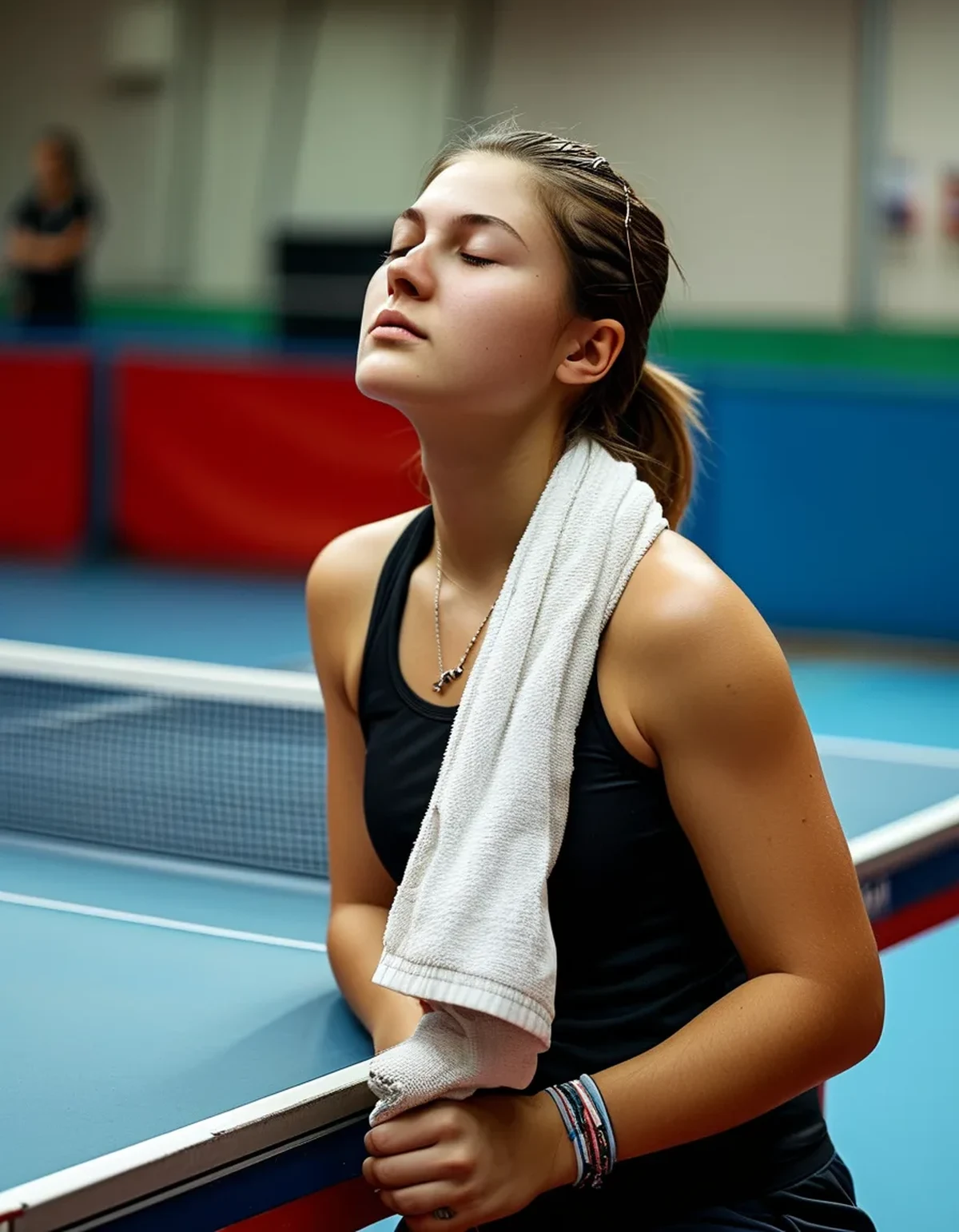
- Towel off at the permitted intervals - it is a built-in reset, which is part of why the rule exists.
- Decide one thing about the next point: where you are serving, or what you are looking for.
- Then step in.
The routine matters more than its contents. A consistent ritual reduces the decision load between points and gives the system a repeated micro-recovery.
And do not analyze the last point. Replaying an error consumes exactly the resource that is running out, and it is the most common thing recreational players do while walking back to position.
7 Things That Help More Than Practicing Harder
1. Simplify your tactics as the match progresses. In game three, reduce your options. Two serves you trust and one reliable pattern beats a full repertoire you can no longer choose between. Fewer decisions means better decisions.
2. Train longer, not harder. If you collapse at 45 minutes, practicing intensely for 30 minutes never addresses it. Play sets that extend past your failure point, even at lower intensity.
3. Eat and drink before you need to. Cognitive performance is sensitive to hydration and blood glucose. A match starting two hours after your last meal, with no water, is starting at a deficit - and you will feel it in game three, not game one.
4. Warm up the eyes, not just the arm. Spend two minutes of the knock-up specifically watching your opponent’s racket at contact. It primes the perceptual habit you will need later.
5. Play more matches, not more drills. Drills train strokes; matches train decision-making under pressure. Decision endurance is trained only by deciding.
6. Fix your serve routine first. The serve is the one moment you fully control. A consistent, unhurried serve routine anchors everything else and gives you the longest available pause in the game.
7. Accept that late-game strategy should be boring. Attempting the spectacular shot in game three is a fatigue symptom. Consistency wins the games that flair loses.
Does the season change anything?
Indoor conditions shift as autumn arrives, and a few of them matter more than they sound.
Heating comes on and humidity drops. Dry air affects grip and ball behavior, and hands sweat differently in a heated hall than in a summer one. If your grip changes late in a match, it may be the room rather than your technique.
Cooler halls need longer warm-ups. Cold muscles react more slowly, and the first game in a cold hall is not a fair sample of your form - which is worth knowing before you conclude anything from it.
Lighting is the underrated one. Shorter days mean more play under artificial light, and artificial lighting is often less even than daylight, adding perceptual load exactly where your attention is already stretched. If a venue’s lighting is poor, expect to fatigue earlier.
Indoor season means more matches per week. Volume rises in autumn as leagues start, and cumulative fatigue across a week shows up as a game-three collapse in the last match rather than as tiredness you would notice.
And it is a good season to train endurance. Longer indoor sessions are easy to schedule in the fall - this is the right time of year to extend session length rather than intensity.
FAQ: Late-Match Fatigue Questions, Answered
How do I tell cognitive from physical fatigue?
Check your breathing between points. If you are not out of breath but you are misreading serves, it is cognitive. Physical fatigue shows up in the legs and in shots that come up short.
Does caffeine help?
It can support alertness for a sustained session, and timing matters - roughly 45 minutes before play, and not so late that it affects sleep. It does not replace between-point recovery or a simplified game plan.
Should I change tactics if I am losing in game three?
Simplify rather than change. A new tactic requires new decisions, which is the resource you are short of. Go back to the two or three patterns you know best and execute them cleanly.
TL;DR:
- Late collapse is usually cognitive, not physical - check whether you are actually out of breath.
- Spin reading fails first because watching the opponent’s contact is the most attention-expensive thing you do.
- Use the full time between points with a fixed routine, and stop replaying the last point.
- Simplify tactics as the match goes on. Fewer options produce better decisions.
- Train longer sessions rather than harder ones, and play matches rather than only drills.
Try the between-point routine in your next session. Most players find game three improves before their strokes have changed at all.
Keep Reading
This article is for general informational and styling purposes only. Fit, sizing, and product availability may vary.