Why Your Footwork Fails on the Wide Forehand
Quick Answer: You reach for wide forehands because your recovery position is too far to the backhand side and your first move is with the wrong foot. Recover slightly to the backhand side of center, and push off with the outside foot so your first step covers ground instead of just turning your body.
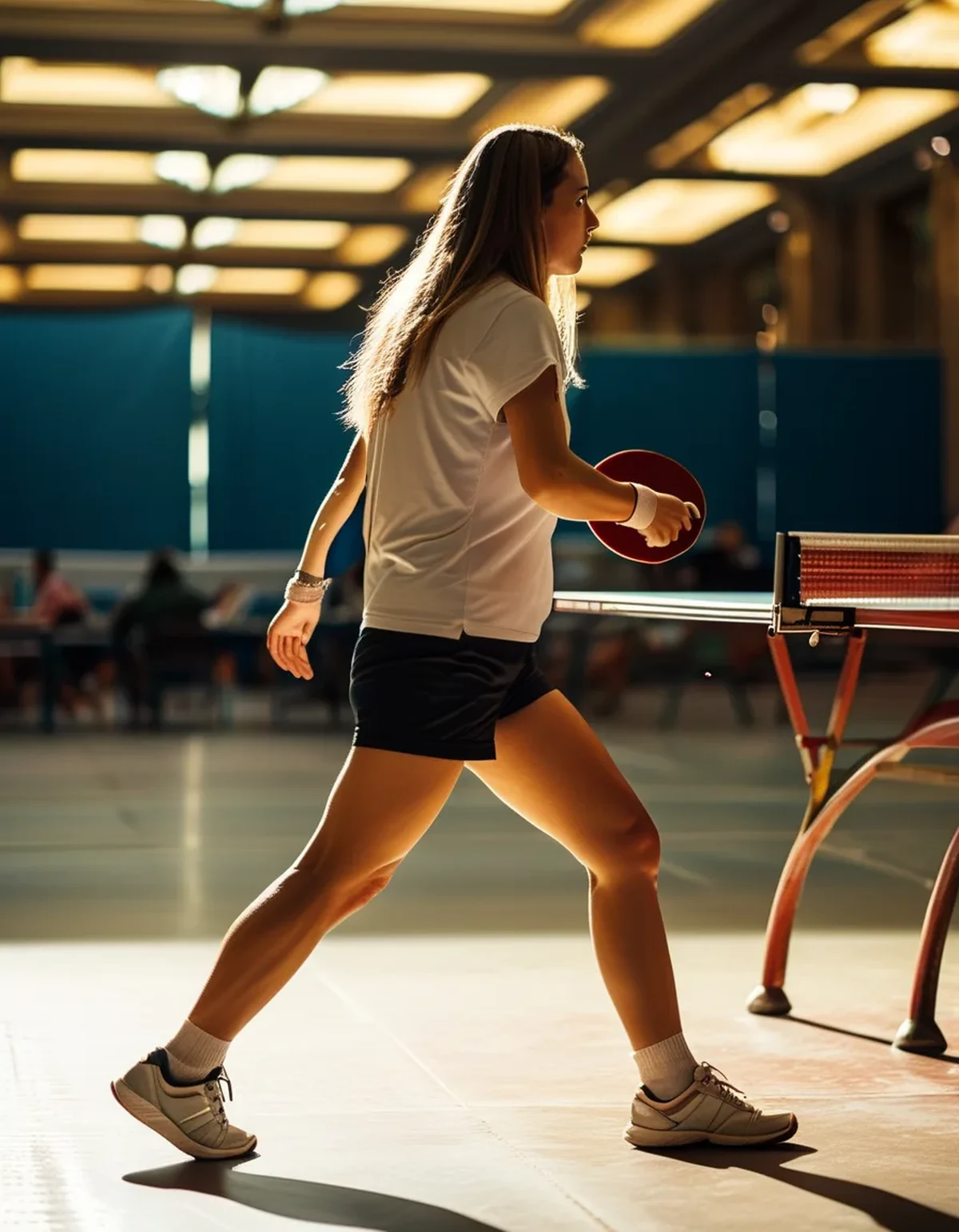
The wide forehand is where rallies go to die. You get there, technically, but the shot has no weight and you are stranded for the next ball. Then you lose the point on the open backhand. The frustrating part is that your forehand is fine when you have time.
Why does the wide forehand expose footwork more than anything else?
Because it demands the longest movement from the most common starting position.
Most players stand slightly left of center if right-handed — a sensible default, since the backhand covers less ground and you want to be able to step around for a forehand. That default means the widest forehand ball is the furthest point on the table from where you start.
It also requires a change of direction under time pressure, and it is the shot where an incorrect first step costs the most. On a backhand, poor footwork produces a cramped shot. On a wide forehand, poor footwork means you do not arrive at all.
The result is a shot most players hit with their arm while their feet are still catching up, which produces exactly the weak, high, predictable ball that gets attacked.
Which foot should move first?
The one furthest from the ball. For a right-hander going wide to the forehand, that is the left foot pushing off, not the right foot stepping out.
This feels backward and it is the single most common error. Stepping first with the near foot — the right — turns your body but does not move your center of mass. You end up reaching, with your weight still where it started.
Pushing off the left foot drives your whole body toward the ball. The right foot then lands in position with your weight already traveling in the right direction, which is what lets you hit through the ball rather than at it.
The drill: stand in ready position and practice ten push-offs with no ball, feeling the left foot drive. Most players discover their instinct is exactly reversed, and the correction transfers within a few sessions.
Where should you actually recover to?
Not to the middle of the table, and not to where you last hit from.
The correct recovery position depends on where you just sent the ball, because it determines the angles available to your opponent. Send a ball wide to their forehand, and their sharpest angle comes back cross-court to your forehand — so you should recover further toward your forehand side than usual.
The general principle: recover to bisect the angles available to your opponent from where the ball actually is. Not to a fixed spot.
Most recreational players recover to the same place every time, which means half their positions are wrong before the ball is even struck. This is why better players seem to have more time — they are not faster, they started closer.
Also recover with small adjusting steps rather than one big move. Small steps let you change direction; a big committed step does not.

Myth vs Fact: Table Tennis Footwork
Myth: Good footwork means being fast. Fact: It means starting early and starting correctly. A player who reads the shot and pushes off properly beats a faster player who starts late with the wrong foot.
Myth: You should always be in the middle of the table. Fact: Correct position depends on where the ball is and what angles exist. Static center positioning is a beginner habit.
Myth: Footwork is separate from the stroke. Fact: The stroke starts in the legs. In a proper forehand, the weight shifts from right foot to left through contact — a forehand hit with no weight transfer is a forehand hit with the arm only.
Myth: Practicing strokes will fix your footwork. Fact: Stationary stroke practice can entrench footwork problems, because you groove a swing that never had to move. Multi-ball footwork drills fix it faster than anything else.
How do you train it specifically?
Three drills, in order of usefulness.
Falkenberg drill. The standard for this exact problem: backhand from the backhand corner, forehand from the backhand corner (stepping around), then forehand from the wide forehand corner. Repeat continuously. It trains both the step-around and the wide recovery in one pattern, and almost every serious player has done thousands of these.
Two-point forehand. Partner or robot alternates wide forehand and middle. Only forehands. Focus entirely on the push-off foot and on landing with weight already moving.
Shadow footwork, no ball. Two minutes, three times a week, moving through the pattern with a proper stroke and no table. It is the cheapest way to build the movement pattern, and it can be done anywhere.
One coaching note: do these at a pace where your footwork stays correct, not at the fastest pace you can survive. Practicing a broken pattern quickly just makes it more permanent.
FAQ: Table Tennis Footwork Questions, Answered
Should I step around my backhand more?
At intermediate levels, yes — the forehand is usually the stronger weapon and stepping around creates attacking opportunities. The requirement is that you can recover to cover the open forehand afterward, which is exactly what the Falkenberg drill trains.
How wide should my stance be?
Wider than feels natural — roughly one and a half times shoulder width, with knees bent and weight forward on the balls of the feet. A narrow stance makes lateral push-off nearly impossible.
Why do my legs get tired before my arm?
Because you are finally using them. Table tennis is far more of a leg sport than it appears, and leg fatigue in practice is usually a sign your footwork is improving rather than a problem.
TL;DR:
- The wide forehand fails because of recovery position and first-step choice, not reach
- Push off with the far foot; stepping with the near foot turns you without moving you
- Recover to bisect your opponent’s available angles, not to a fixed center spot
- Falkenberg drill, two-point forehand, and shadow footwork fix it faster than stroke practice
The encouraging thing about footwork problems is that they respond quickly once you know which foot to move. Spend two minutes on shadow push-offs before your next session and see whether the wide ball still feels like an emergency. For most players it stops being one within a month.
Keep Reading
This article is for general informational and styling purposes only. Fit, sizing, and product availability may vary.