Why Your First Three Points Predict the Whole Match
Quick Answer: The first few points matter disproportionately because both players are still calibrating three things: the speed of the table and ball in that specific hall, the opponent’s spin and pace, and their own timing after warm-up. Whoever calibrates faster wins the early points, and early points shape shot selection for both players for the rest of the game. The practical response is to make the opening points about information gathering rather than winners.
Players who lose the first three points and then complain about a slow start usually did not have a slow start. They had no plan for the calibration phase.

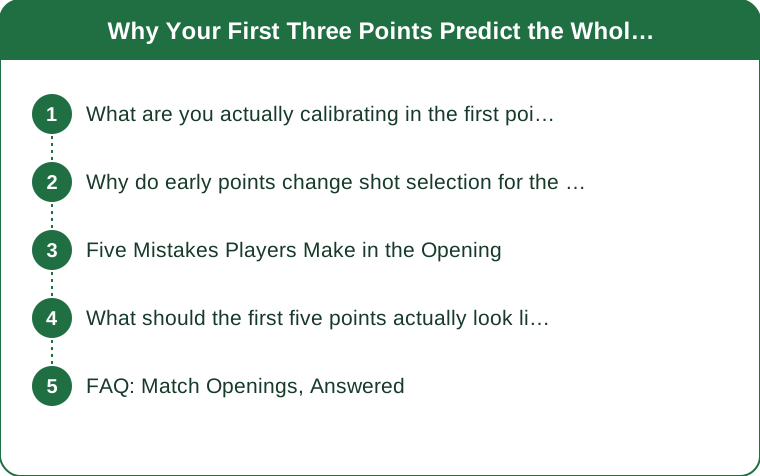
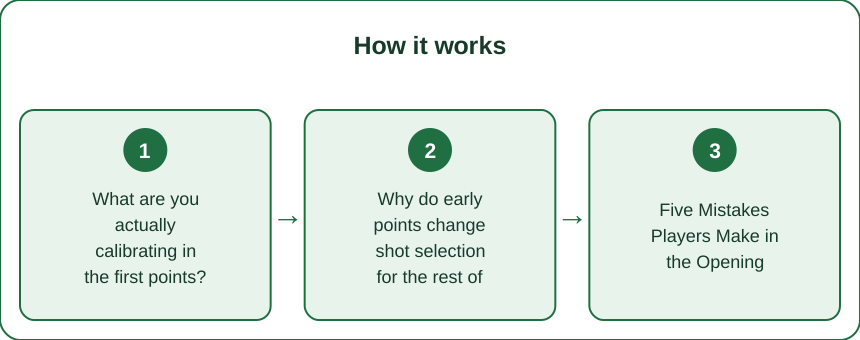
What are you actually calibrating in the first points?
Three variables, all of which change from venue to venue.
Table and ball speed. Table surfaces vary, and so do balls between brands and batches. A faster table means the ball arrives sooner and bounces longer; a slower one means the opposite. Your timing is set from your home table, and it will be slightly wrong here.
Air and floor conditions. Humidity affects both the ball’s flight and your rubber’s grip. A humid hall produces less spin and a slower ball. Lighting affects your ability to read spin from the ball’s logo rotation, which many players rely on without realizing.
The opponent’s spin signature. Every player imparts spin differently. Reading whether a serve is heavy backspin or a float takes a handful of repetitions, and the first ones will be wrong.
The deeper issue is that your errors during calibration are not random — they are systematic. If the table is faster than you expect, you will be consistently late, which produces a specific pattern of errors. Recognizing the pattern rather than the individual mistakes is what lets you adjust in two points instead of eight.
Why do early points change shot selection for the rest of the game?
Because both players update their model of the match, often on very little evidence.
A player who wins the first three points concludes their game plan is working and commits to it. A player who loses them starts hunting for changes — different serves, different placement, more risk. That hunt is usually the more damaging response, because it abandons a plan that had not actually been tested yet.
There is a specific pattern worth naming. A player who loses early points on unforced errors often responds by playing more safely, which reduces their own threat and lets a confident opponent dictate. A player who loses early points to opponent winners often responds by taking more risk, which increases their own error rate.
Both responses are overreactions to a sample of three points during a phase when both players were miscalibrated anyway.
The better model: treat the first five points as a data-gathering phase with a low expectation of winning them. Play high-percentage shots, watch what the opponent does with them, and expect to be adjusting rather than executing. Then the actual match begins around 5-5 with you holding better information than you would have had otherwise.
This is not passivity — it is deliberately trading a small chance of an early lead for a much better read on the opponent.

Five Mistakes Players Make in the Opening
Serving your best serve first. Your most effective serve is most effective as a surprise. Using it at 0-0 lets the opponent see it, adjust to it, and neutralize it by the time it actually matters at 8-8. Open with a serve that gathers information — a long fast serve tells you about their reaction time, a short backspin tells you about their touch.
Warming up only forehands. Most warm-ups drift into comfortable forehand-to-forehand rallies. That means the first backhand of the match is genuinely your first backhand of the day, at exactly the moment when the ball speed is still unfamiliar.
Not testing their backhand early. You need to know which side is weaker, and asking that question at 9-9 is too late. Direct the second and third points there specifically, even if you lose them — the information is worth more than the points.
Treating a lost first game as a lost match. In a best-of-five, the first game is the calibration game. Players who understand this routinely lose the first and win the match, because they used it to learn while their opponent used it to celebrate.
Copying the opponent’s pace. If they hit hard and fast, most players reflexively match it, even when their own game is built on spin and placement. Playing your game slightly worse beats playing their game slightly better, almost every time.
What should the first five points actually look like?
Structured information gathering, with a specific question per point.
Point 1: their return of a long serve. Serve long and fast to the middle. Watch whether they step around, block, or attack. This tells you their default reaction and their footwork readiness.
Point 2: their touch on a short ball. Serve short with backspin. Watch whether they push, flick, or hesitate. Hesitation on short balls is one of the most exploitable weaknesses at club level.
Point 3: their backhand under pace. Get a rally going and direct two consecutive balls to the backhand. You are looking for whether the second one gets weaker.
Point 4: their response to a change of pace. Take pace off deliberately. Many attacking players struggle far more with a slow ball than a fast one, because they have to generate their own power.
Point 5: their read on spin. Give them the same motion with different spin. Whether they read it tells you how much your serve variation will be worth later.
By 2-3 or 3-2, you have a genuine picture of the match. You have also calibrated to the table without having to think about it, because five points of varied play does what a warm-up rally does not.
And if you happen to win those five points because the opponent’s weaknesses are severe — that is a fine outcome too. The point is that you learn either way.
FAQ: Match Openings, Answered
Does the warm-up not handle calibration?
Partly, but warm-up rallies are cooperative and slow, and match play is neither. The specific timing you need at match pace is not what a warm-up gives you, which is why so many players feel a step behind for the first game.
How much does the first game matter in a best-of-five?
Statistically it correlates with winning, but a large part of that correlation is simply that better players win both. Treating the first game as decisive is the mistake — treating it as informative is the advantage.
What if my opponent also plays this way?
Then you both gather good information and the match is decided later on quality rather than on early confusion, which is generally the better match for whoever is more skilled. There is no downside to being the better-informed player.
TL;DR:
- The first points are a calibration phase for table speed, conditions, and the opponent’s spin.
- Losing them usually triggers an overreaction that costs more than the points did.
- Save your best serve; open with serves that gather information instead.
- Assign a specific question to each of the first five points, and expect to learn rather than to win them.
Next match, write down the five questions before you start. Knowing what you are looking for turns the opening from a stumble into an advantage.
Keep Reading
This article is for general informational and styling purposes only. Fit, sizing, and product availability may vary.