Why You Improve Faster Playing Someone Worse Than You
Quick Answer: Skill development requires repetition at the edge of your ability with enough time to execute deliberately. Against a much stronger opponent you are in constant recovery, defaulting to your safest existing habits, which reinforces them rather than expanding them. Against a slightly weaker opponent you have time to attempt new shots, tolerate errors and get repetitions. The most efficient improvement usually comes from opponents somewhat below your level for skill acquisition and somewhat above for pressure testing.
Everyone tells you to play up. Play stronger players, they said.
You did that for three months and your game did not change, except that your defensive push got very reliable.
That is exactly what should have happened.
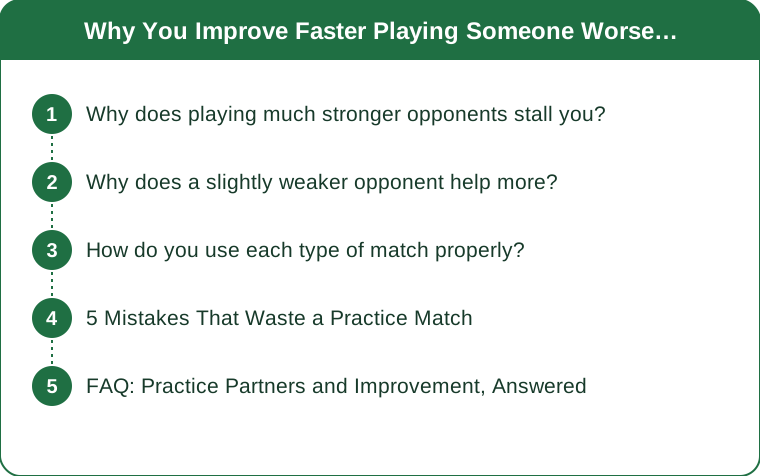
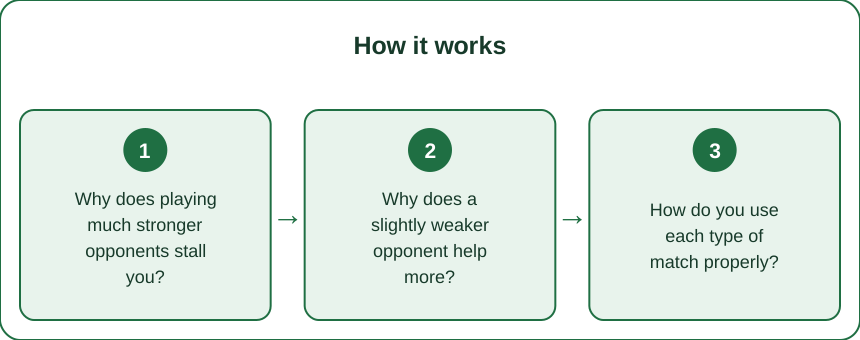
Why does playing much stronger opponents stall you?
Because survival mode reinforces existing habits rather than building new ones.
You default to your safest shot. Under time pressure, the brain selects the most practised option available. That is your existing game, not your developing one.
You get fewer meaningful repetitions. Rallies against a much stronger player are short. Fewer balls per game means less practice, not more.
Time pressure prevents deliberate execution. Learning a new stroke requires enough time to think about the movement. At high speed, there is not enough.
Error feedback becomes uninformative. When every point ends quickly, you cannot tell whether you missed because your new technique is wrong or because the ball was simply too good.
It is discouraging in a way that matters. Motivation is a real input into practice volume, and a long run of heavy losses reliably reduces how much you play.
What it is genuinely good for. Pressure testing, tactical exposure and seeing what a shot should look like. Those are real benefits, and they are different from skill acquisition.
Why does a slightly weaker opponent help more?
Because you get to choose, and choice is where learning happens.
You have time to execute deliberately. A slower ball gives you the fraction of a second needed to attempt the technique you are working on rather than the one you already own.
You can afford to lose points experimenting. Learning requires error tolerance. If every mistake loses the game, you will not risk anything.
Rallies last longer. More balls per game is more repetitions, which is the raw material of skill.
You control the situation. You can deliberately create the scenario you want to practise, which is close to structured drilling with a competitive edge.
Your errors are informative. When the ball is manageable, a miss is genuinely your technique. That is usable feedback.
The caveat. It only works if you actually use the freedom. Beating a weaker player with your existing safe game teaches you nothing, and this is exactly what most players do.
How do you use each type of match properly?
Give each opponent a job, and decide before you start.
Against weaker players: set a constraint. Only backhand topspin. Serve only long. No smashing. The constraint forces the practice and levels the match at the same time.
Against stronger players: pick one thing to test. Not your whole game. Just your serve return, or your positioning. Everything else is allowed to be bad.
Against equal players: play to win. This is your competitive practice, where tactics and pressure management are trained.
Aim for a rough weekly split. Something like half your time on skill acquisition against equal or slightly weaker players, a quarter on pressure against stronger players and a quarter on structured drilling, works well for most club players.
Track something other than the score. Count how many times you attempted the shot you are working on. That is the number that predicts improvement.
Autumn note: club seasons restart in September, which means new players and a reshuffled ladder. It is the best time of year to deliberately choose who you play rather than defaulting to whoever is free, and the choice compounds over the winter season.
5 Mistakes That Waste a Practice Match
Playing to win against a weaker player. You confirm your existing game and learn nothing. Set a constraint instead.
Playing your whole game against a much stronger player. Everything breaks at once and you cannot tell what failed. Pick one element.
Never playing anyone weaker. The play-up advice is half of a strategy presented as all of one.
Abandoning a new shot after a bad session. New techniques get worse before they get better, because you are unlearning a working alternative. Give any change at least six to eight sessions.
Not warming up the thing you are practising. Ten minutes of the specific shot before the match is worth more than the match itself.
And the sneaky one: playing the same two opponents every week. Style diversity matters enormously in table tennis, and a player who only faces two styles develops a game that collapses against a third.
FAQ: Practice Partners and Improvement, Answered
So should I stop playing better players?
No. Use them for pressure testing and pattern exposure, just not as your main source of skill development.
How much weaker should a practice partner be?
Enough that you win comfortably but still have to play properly. If you can win without trying, add a constraint.
Does drilling beat playing matches?
For technique, yes, clearly. Matches add decision-making and pressure that drills cannot. Both are needed.
How long before a new shot works in matches?
Commonly six to eight weeks of regular practice before it becomes reliable under pressure, and it will feel worse before it feels better.
Is a robot or multiball worth it?
For repetitions, extremely. Multiball with a partner is one of the highest-value hours in table tennis.
How do I keep weaker opponents interested?
Constraints level the match naturally. Playing backhand-only against a weaker player usually makes for a genuinely close and enjoyable game for both of you.
TL;DR:
- Strong opponents push you into survival mode, reinforcing existing habits rather than new ones.
- Slightly weaker opponents give you time, repetitions and error tolerance — the conditions for learning.
- Give each match a job: constraints against weaker players, one test element against stronger ones.
- Track attempts at your target shot, not the score.
- Expect a new shot to take six to eight weeks and to get worse first.
Next match against someone you always beat, play backhand only. You will learn more than in a month of losing.
Keep Reading
This article is for general informational and styling purposes only. Fit, sizing, and product availability may vary.