Why Changing Tables or Venues Throws Off Your Timing Completely
Quick Answer: Table tennis timing is built on a set of environmental constants you never consciously registered: how much the table surface bounces, the lighting and background you track the ball against, the amount of space behind the table, and the temperature and humidity affecting the ball and your grip. Change venue and several of those change at once, so the timing your brain built for one environment misfires. Adaptation takes roughly ten to fifteen minutes of deliberate warm-up, and knowing what to check speeds it up considerably.
You beat the same opponent every week at home. You play them at their club and you cannot find the table.
The usual explanation is nerves, and nerves are part of it. Underneath that is a set of specific physical differences, each of which is measurable and adjustable.

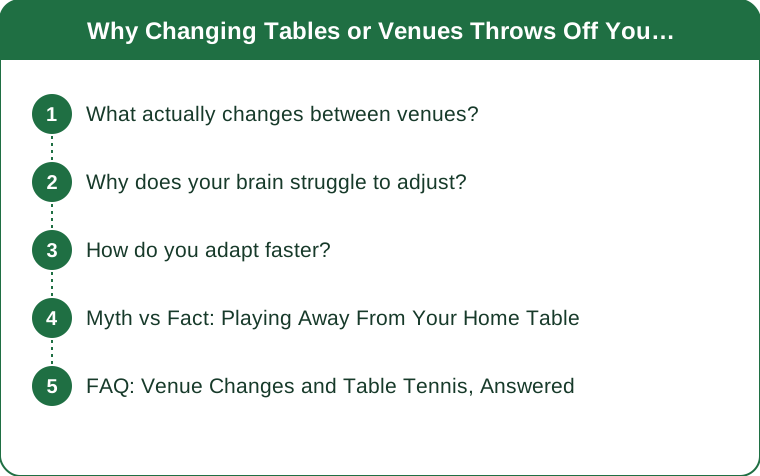
What actually changes between venues?
Four variables, and they compound.
Table surface and bounce. Regulation tables must produce a standard bounce height from a set drop, and in practice tables vary considerably. Older tables, cheaper tables, and tables with worn surfaces bounce lower and deader. A ball that sits up on your home table and skids at a new venue changes the contact point for every single shot.
Lighting and background. This is the largest and least appreciated factor. Your ability to track a fast small object depends on contrast against the background. Bright even overhead lighting with a dark surround is ideal. A venue with windows, mixed lighting, low ceilings with glare, or a pale cluttered background behind the table makes the ball genuinely harder to see, and the effect on your timing is direct.
Space behind and beside the table. Playing area size changes what shots are available. A cramped venue forces you to take the ball earlier, which is a different timing pattern entirely from stepping back and playing it later. Players who develop in a large hall often struggle in a small one and assume they are playing badly.
Temperature and humidity. Humid air slows the ball slightly and affects spin, and more importantly it affects your grip and how much the ball skids off the rubber. A cold hall makes rubber harder and less grippy, which reduces the spin you can generate. This blog has covered how rubber type changes the game, and temperature changes what your existing rubber does.
And the floor. Grip underfoot determines how confidently you move. A dusty or slippery floor makes players shorten their footwork without noticing, which this blog has covered as small steps being the foundation of everything else.
Why does your brain struggle to adjust?
Because timing in fast sports is predictive, not reactive.
You cannot react to a table tennis ball in the usual sense. At competitive speeds the ball crosses the table in a fraction of the time simple reaction would require. What you are actually doing is predicting where it will be based on what you saw at contact, and moving to that predicted point in advance.
Prediction is built on a learned model of the environment. Your brain has an internal model of how the ball behaves on your table, in your light, with your bat. That model is precise and it is specific.
Change the environment and the model is subtly wrong. Not wrong enough to be obviously broken, wrong enough that you arrive a fraction late or contact the ball a centimetre off centre. In a sport with these margins, a small model error produces a large drop in performance.
Which is why it feels like your technique has vanished. Your technique is fine. Your predictions are off, and technique executed at the wrong moment looks like bad technique.
This blog has covered how reaction time training does not transfer between contexts, and this is the same phenomenon from the other direction. The skill is environment-specific to a degree that surprises people.
And it explains why the adjustment is fast once it happens. Recalibrating a model takes a modest number of repetitions with feedback, which is roughly ten to fifteen minutes of hitting. It does not take weeks, and it does take longer than the two-minute knock-up most casual matches allow.

How do you adapt faster?
Deliberately, and in a specific order.
Arrive early enough to hit for fifteen minutes. This is the whole answer and it is the thing nobody does. A proper knock-up is not a courtesy, it is the recalibration process.
Test the bounce first, before anything else. Bounce a ball on the table a few times and hit some flat drives. You are asking whether the table is lively or dead, which determines your contact point for the entire match.
Then test spin response. Push a few balls with heavy backspin and see how much they skid or sit. Serve a few. The interaction of table surface, ball, and your rubber determines how much your spin actually does at this venue.
Check the lighting from your end and theirs. Look for glare, shadows, and what the background behind your opponent looks like. If there is a window or a bright patch behind the table at one end, that end is genuinely harder, and knowing it before the match beats discovering it at 8-8.
Walk the space behind the table. Find out how far back you can actually go. Adjust your expectations rather than discovering the wall mid-rally.
Warm up your footwork on the actual floor. Do a few side steps and check the grip. Adjusting shoe choice or wiping the soles takes seconds and prevents the shortened footwork problem.
Accept the first game as calibration. Even with a good warm-up, the first game at a new venue is usually the worst. Playing it as a tuning exercise rather than as a disaster keeps you from making technique changes in response to an environment problem, which is the mistake that turns a slow start into a lost match.
Myth vs Fact: Playing Away From Your Home Table
Myth: If your technique is good, the venue does not matter. Fact: Timing in table tennis is predictive and built on environment-specific expectations. Better players adapt faster, and they still need to adapt. Even top professionals train on the exact table model and ball used at major events for this reason.
Myth: The ball is standardised, so the bounce is the same everywhere. Fact: Balls are standardised and tables vary substantially in surface, age, and quality. A worn table produces a noticeably lower and deader bounce, which changes your contact point on every shot.
Myth: Lighting only matters at a professional level. Fact: Lighting is arguably the biggest environmental variable at every level. Tracking a fast small object depends on contrast, and a venue with glare, mixed lighting, or a pale background makes the ball genuinely harder to see.
Myth: You should change your technique when it stops working away from home. Fact: This is the classic error. Making technical changes in response to an environmental mismatch introduces a real fault to compensate for a temporary one, and it survives after you go home.
Myth: A two-minute knock-up is enough. Fact: It is what the rules allow before a match, and it is not enough to recalibrate. Arriving fifteen minutes early to hit is worth more than any tactical preparation.
Myth: Cold halls only affect comfort. Fact: Cold makes rubber harder and less grippy, which measurably reduces the spin you can generate. As autumn arrives and halls get colder, players frequently find their heavy topspin stops biting and blame their form.
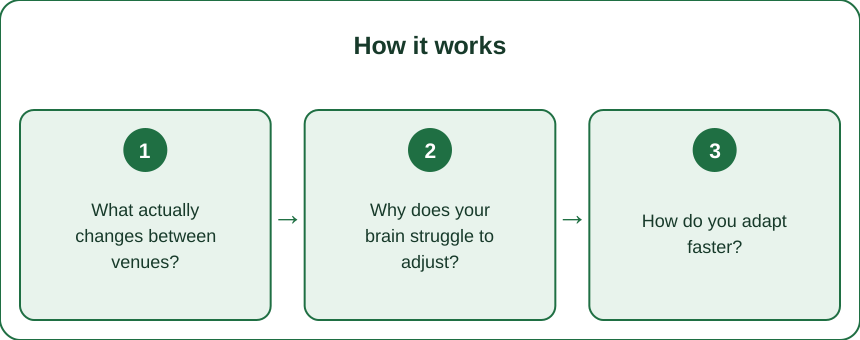
FAQ: Venue Changes and Table Tennis, Answered
Why do I play worse at other venues?
Because your timing is a predictive model built on your home table’s bounce, lighting, space, and conditions. Change several of those at once and the predictions are slightly off, which looks like your technique has deserted you.
How long does it take to adjust to a new table?
Roughly ten to fifteen minutes of deliberate hitting, testing bounce first and then spin response. The two-minute knock-up allowed before a match is not enough, which is why the first game away is usually the worst.
Does hall temperature really affect play?
Yes. Cold makes rubber harder and less grippy, reducing the spin you can generate, and humid air slows the ball. Players in cold autumn halls often find their topspin stops biting and assume it is a form problem.
TL;DR:
- Timing in table tennis is predictive and built on environment-specific expectations, so changing venue misfires the prediction rather than the technique.
- The four variables are table bounce, lighting and background, space behind the table, and temperature affecting rubber grip.
- Arrive fifteen minutes early and test bounce first, then spin, then check lighting and floor grip.
- Never change your technique in response to an away-venue slump. You will fix a temporary problem by creating a permanent one.
Next away match, bounce the ball on the table before you do anything else. It is the first thing your prediction model needs.
Keep Reading
This article is for general informational and styling purposes only. Fit, sizing, and product availability may vary.