The Actual Mechanism Behind Table Tennis's Reputation as a 'Brain Sport'
Quick Answer: Table tennis’s cognitive benefit comes primarily from the combination of extremely fast visual tracking, rapid decision-making under time pressure, and continuous whole-body coordination happening simultaneously, which engages multiple brain regions — visual processing, motor planning, and executive function — at once in a way most steady-state exercise doesn’t, and some research specifically points to this multi-system demand as more stimulating for certain cognitive functions than exercise alone.
The “brain sport” reputation isn’t vague marketing — it points to a specific, real mechanism: table tennis forces the brain to process visual information, make rapid decisions, and coordinate complex movement all at once, repeatedly, for the length of a match.

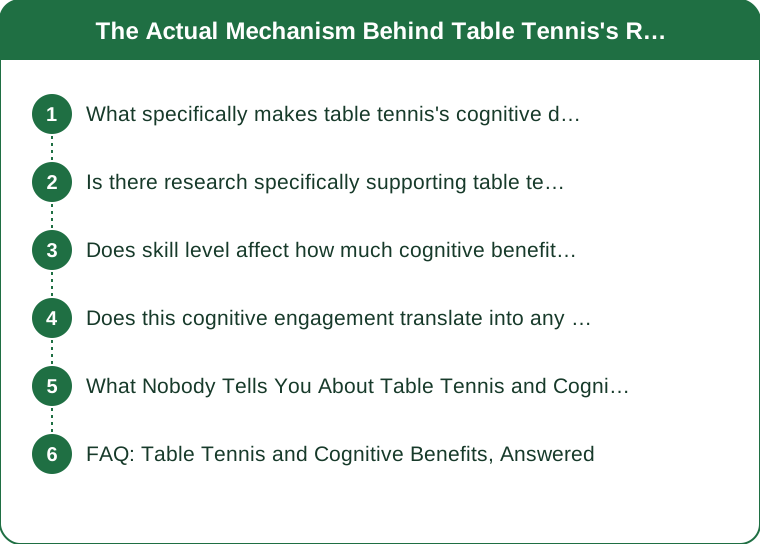
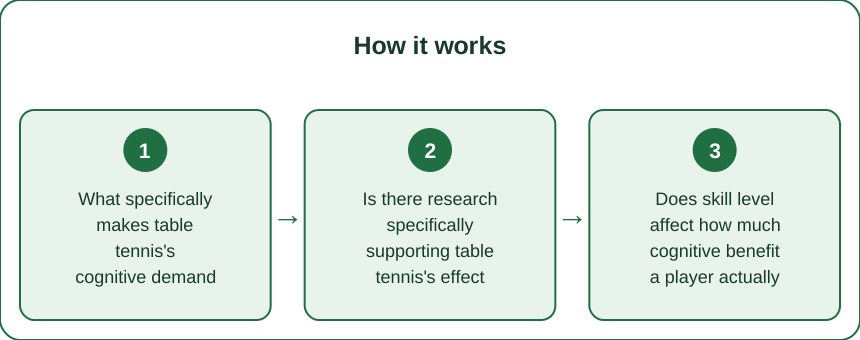
What specifically makes table tennis’s cognitive demand different from steady-state cardio exercise?
Steady-state cardio, like a treadmill run, primarily provides the general cognitive benefits of increased blood flow and cardiovascular fitness, without requiring rapid, continuously changing decision-making. Table tennis, by contrast, requires processing a fast-moving ball’s trajectory, spin, and speed, then rapidly selecting and executing a specific motor response, all within a fraction of a second, repeatedly — this combination of visual processing, rapid decision-making, and motor execution happening together is what distinguishes its cognitive demand from most other exercise.
Is there research specifically supporting table tennis’s effect on brain function, or is this mostly anecdotal?
There’s a growing body of research, including studies using neuroimaging, that has found table tennis play associated with increased activity in brain regions related to visual-motor coordination and executive function, and some studies specifically comparing it to other exercise types have found distinct patterns of cognitive engagement. While research in this specific area is still developing, the mechanistic argument — simultaneous fast visual processing, decision-making, and motor coordination — is well-grounded in what’s already understood about cognitive demand generally.
Does skill level affect how much cognitive benefit a player actually gets from playing?
To some degree — a complete beginner spends more mental effort on basic motor execution (getting the paddle to make contact at all) than on the higher-level visual-processing and decision-making demands more advanced players face during fast rallies. This suggests the cognitive benefit may become more pronounced as basic motor skill becomes more automatic, freeing up more mental resources for the visual-tracking and rapid-decision components specifically.

Does this cognitive engagement translate into any real-world, everyday cognitive benefit, or is it specific to table tennis performance itself?
Some research on visual-motor and executive function training suggests genuine transfer to broader reaction time and processing speed measures, beyond just table tennis performance specifically, though the strength and durability of this transfer effect is still an active area of research. The mechanistic plausibility is strong, given how directly the sport engages these general cognitive systems, even if definitive long-term real-world transfer data is still developing.
What Nobody Tells You About Table Tennis and Cognitive Training
Playing against a more skilled opponent produces meaningfully more cognitive challenge than playing against an equally matched or weaker opponent, since a stronger opponent’s shots require faster, more varied processing and response — deliberately seeking out slightly more challenging opponents, rather than staying in a comfortable skill-matched pairing, may be a genuinely underused way to maximize the cognitive-training aspect of regular play.
FAQ: Table Tennis and Cognitive Benefits, Answered
How often does table tennis need to be played to see any meaningful cognitive benefit?
Most research in this area studies regular players (multiple sessions per week over extended periods), so occasional casual play likely provides some benefit but the more established research reflects a more consistent practice pattern.
Are other racket or ball sports similarly cognitively demanding, or is table tennis unique?
Other fast-reaction sports like badminton or squash share some of the same visual-processing and rapid-decision demands, though table tennis’s particularly short reaction window (due to the short table distance) is sometimes cited as an especially concentrated version of this demand.
Is table tennis considered beneficial for cognitive health across all age groups, including older adults?
Yes, and it’s specifically studied and recommended in some contexts for older adults, given its combination of physical activity, social interaction, and the specific visual-motor cognitive demands discussed above. This is general information, not medical advice.
TL;DR:
- Table tennis combines fast visual tracking, rapid decision-making, and motor coordination simultaneously
- This combination distinguishes its cognitive demand from steady-state cardio exercise specifically
- Research suggests distinct patterns of brain engagement, though long-term transfer effects are still developing
- Playing against slightly more skilled opponents may meaningfully increase the cognitive-training benefit
Table tennis’s brain sport reputation traces to a real, specific mechanism — the simultaneous demand on visual processing, decision-making, and coordination that few other activities replicate as intensely.
Keep Reading
This article is for general informational and styling purposes only. Fit, sizing, and product availability may vary.