How Table Tennis Actually Trains Your Reaction Time (And How to Speed It Up Faster)
Quick Answer: Table tennis trains reaction time through repeated exposure to a fast, unpredictable stimulus at close range — the ball can reach you in under 0.3 seconds at competitive level. Close-range, low-ball-count drills speed up this adaptation faster than full games do.
A table tennis ball can cover the table in a fraction of a second, which is exactly why the sport is used in reaction-time research. Here’s what’s actually happening neurologically, and how to train it more deliberately than just playing games.
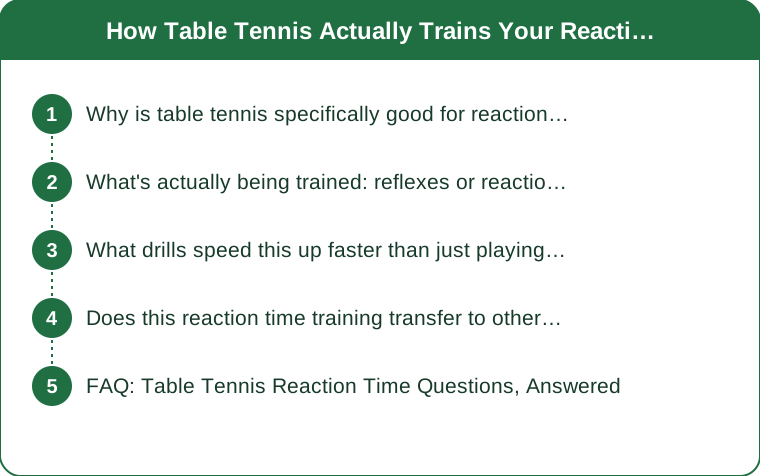
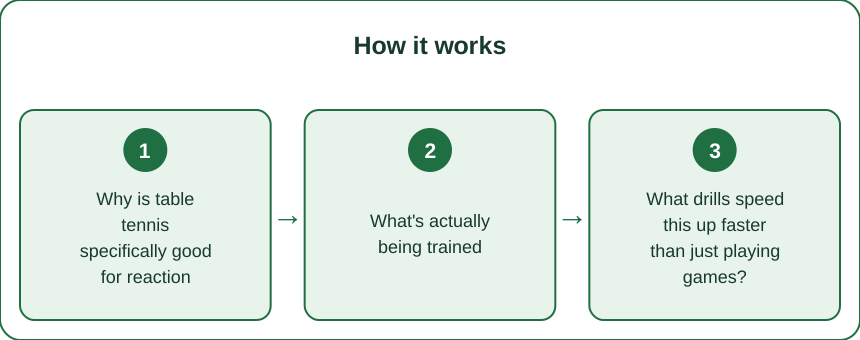
Why is table tennis specifically good for reaction time?
The short table distance and high ball speed mean players have as little as 0.2-0.3 seconds to read spin, trajectory, and speed, then execute a response — that’s a genuinely demanding visual-motor processing loop, repeated hundreds of times in a single session, which is a lot of adaptation-triggering repetition packed into a short period.
What’s actually being trained: reflexes or reaction time?
It’s reaction time, not pure reflex — a true reflex (like pulling your hand off a hot stove) bypasses conscious processing entirely. Table tennis trains your brain to process visual information and select a response faster, which is a trainable skill distinct from involuntary reflexes, and it’s why dedicated practice genuinely improves it rather than being purely genetic.

What drills speed this up faster than just playing games?
Close-table multi-ball drills — a coach or partner feeding balls rapidly from close range — expose you to far more reaction reps per minute than a normal rally, where points and rest between serves dilute the actual training stimulus. Randomized direction drills (partner alternates left/right unpredictably) train the specific unpredictability that regular games only offer inconsistently.
Does this reaction time training transfer to other areas?
Some research on table tennis players shows improved visual-motor reaction time that carries over to general reaction speed tests, though the effect is most pronounced for reaction demands similar to the sport itself (fast, close-range, visually-driven) rather than being a universal reflex upgrade for every context.
FAQ: Table Tennis Reaction Time Questions, Answered
How long before I notice faster reaction time from table tennis?
Many players report noticeable improvement in return consistency within 4-6 weeks of regular practice, 2-3 sessions a week.
Is table tennis better for reaction time than other racquet sports?
The shorter distance and higher relative ball speed give it a faster reaction-time demand than most racquet sports, though tennis and badminton offer their own valuable variations.
Can older adults still improve reaction time through table tennis?
Yes — studies on older adult table tennis players show measurable reaction time benefits, and the sport is often recommended specifically for this reason alongside its cognitive benefits.
TL;DR:
- Table tennis demands a response in as little as 0.2-0.3 seconds — genuinely elite reaction training
- It’s reaction time (trainable processing speed), not pure reflex
- Close-range multi-ball and randomized-direction drills train faster than regular games
- Benefits often show within 4-6 weeks of consistent 2-3x weekly practice
The speed that makes table tennis frustrating for beginners is exactly what makes it such effective training.
Keep Reading
This article is for general informational and styling purposes only. Fit, sizing, and product availability may vary.