Shakehand vs Penhold: Which Table Tennis Grip Should You Actually Learn?
Quick Answer: Shakehand grip (like shaking hands with the paddle) is the better default for most beginners — it’s more versatile for both forehand and backhand power, and nearly all coaching resources and equipment assume it. Penhold suits players prioritizing quick forehand attacks and offers less natural backhand power.
You pick up a paddle for the first time and nobody tells you there are two fundamentally different ways to hold it — and that choice quietly shapes your whole game from that point forward.

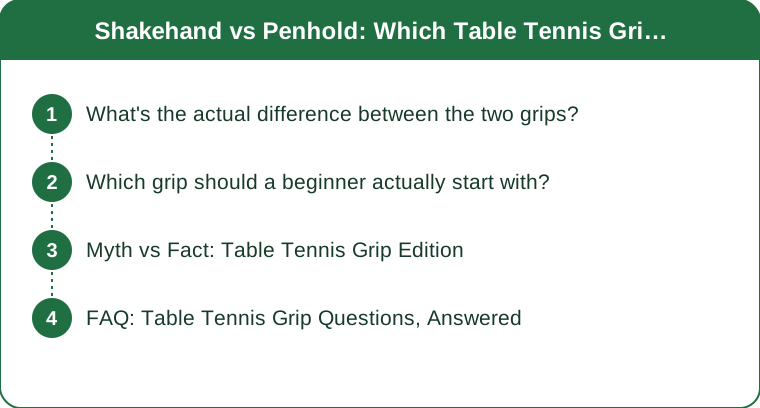
What’s the actual difference between the two grips?
Shakehand: You hold the paddle like shaking a hand, using both sides of the blade for forehand and backhand strokes. It’s the dominant grip in Western table tennis and international competition broadly.
Penhold: You grip the handle like holding a pen, typically using only one side of the blade (traditional Chinese style) or both sides (reverse penhold, more advanced). It excels at fast, aggressive forehand play close to the table but makes backhand strokes structurally harder to generate power with.
Which grip should a beginner actually start with?
Shakehand, for most people. It has a genuinely balanced backhand and forehand from day one, which matters enormously for beginners still building fundamentals on both sides. Nearly all instructional content, coaching, and standard equipment defaults to this grip, which also makes learning resources easier to find.
Penhold rewards players who commit fully to an aggressive, forehand-dominant style and are willing to put extra work into backhand workarounds (like the reverse penhold backhand) — a bigger commitment for a first-time player.

Myth vs Fact: Table Tennis Grip Edition
Myth: Penhold is outdated and no longer competitive. Fact: Top penhold players still compete at elite levels using the reverse penhold backhand technique — it’s a legitimate, evolving style, just a steeper learning curve.
Myth: You can’t switch grips once you’ve learned one. Fact: Switching is genuinely hard after months of muscle memory, but far from impossible in the first few weeks — the earlier you decide, the easier the switch.
Myth: Grip choice doesn’t matter much for casual players. Fact: It shapes footwork, positioning, and shot selection from the very first rally — casual players still benefit from picking deliberately rather than by accident.
FAQ: Table Tennis Grip Questions, Answered
Can I try both grips before committing?
Yes, and it’s a good idea — hit for 15-20 minutes with each over a session or two before locking in, since the feel is hard to judge in the first few minutes.
Does grip choice affect which paddle I should buy?
Somewhat — penhold-specific blades have a different handle shape, so knowing your grip first avoids buying the wrong paddle style.
Is one grip objectively better for beginners with a smaller hand?
Not definitively — comfort varies by hand size and shape more than any general rule, so a quick in-store trial of both beats reading grip size charts.
TL;DR:
- Shakehand is the more balanced, beginner-friendly default with strong resources available
- Penhold rewards an aggressive forehand style but needs extra work for backhand power
- Grip choice shapes footwork and shot selection from your very first rally
- Try both briefly before committing — switching gets much harder after a few months
Pick up a paddle both ways before your next session and notice which feels more natural within 10 minutes.
Keep Reading
This article is for general informational and styling purposes only. Fit, sizing, and product availability may vary.