Ping Pong Serve Tips: 6 Fixes for the Most Common Faults
Quick Answer: The six faults that account for most serve problems are a low toss, contact too far from the body, hitting through the ball rather than across it, an identical swing for every serve, standing too upright, and serving too long. Each has a specific fix, and the first three change your spin immediately.
A serve is the only shot in table tennis where your opponent cannot interfere.
It is also the shot most people never deliberately practise.
This is general information, not medical advice.

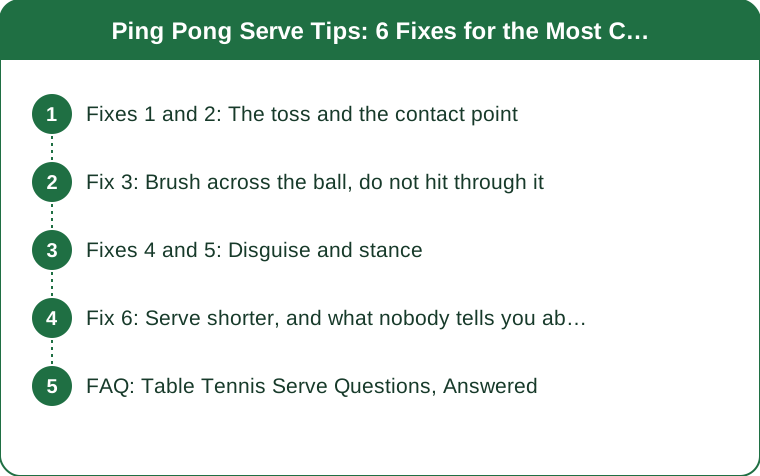
Fixes 1 and 2: The toss and the contact point
Fix 1: Toss higher than you think, and straight up
The rules require the ball to be tossed at least 16 cm vertically from an open palm — but the practical point is that a higher toss gives you more time and more speed at contact. A ball falling from higher is moving faster when you strike it, and more contact speed means more spin for the same swing.
The common fault is a low, forward-drifting toss that gives you almost no window and forces you to reach. If your serves feel rushed, this is usually why.
The fix: toss from an open flat palm, straight up, to roughly head height while you learn. Practise the toss alone, with no bat, twenty times. It is the least interesting drill in table tennis and it fixes more serves than any other.
Fix 2: Contact the ball close to your body and low over the table
Reaching out for the ball costs you control and spin at the same time. The arm is at its most extended and least accurate, and you cannot generate the wrist snap that produces heavy spin.
The fix: let the ball drop closer to you and contact it low, near the table surface. A lower contact point makes it far easier to keep the serve short, which is the single most useful property a serve can have.
Fix 3: Brush across the ball, do not hit through it
This is the difference between a serve with spin and a serve that simply crosses the net.
Spin comes from a tangential contact — the racket brushing across the surface of the ball — not from a direct strike. Beginners almost universally hit through the ball, which produces speed and no spin, and a serve with speed and no spin is the easiest thing in the sport to attack.
The fix: aim to feel the ball travel across the rubber rather than into it. Two checks that tell you it is working:
- Sound. A brushing contact is quiet. A loud click means you hit through it.
- Speed. A heavily spun serve should look slow. If your spin serve is fast, it is not a spin serve.
A useful drill: serve so that the ball bounces on your side of the table, crosses, and then comes back toward the net on the other side. That backspin return is only possible with genuine brushing contact, and it is unambiguous feedback — either the ball comes back or it does not.
How do I know which spin I am producing?
The direction of the brush determines it. Brushing downward under the ball produces backspin; brushing up the back produces topspin; brushing across the side produces sidespin. Most effective serves combine two of these.

Fixes 4 and 5: Disguise and stance
Fix 4: Make different serves look the same
An opponent reads your serve from your racket action, not from the ball. If your backspin serve has an obviously downward swing and your topspin serve an obviously upward one, they are reading it before the ball is struck.
The fix: keep the preparation identical and change only the final moment of contact. Same stance, same toss, same backswing — then vary the racket angle and brush direction in the last few centimetres. This is the difference between a serve that is technically good and one that actually wins points.
A simpler version that works immediately: after contact, continue the swing in the same direction regardless of what you did. A follow-through that matches every serve removes a large amount of information.
Fix 5: Get lower and turn your body in
Standing upright and serving with the arm alone limits both spin and disguise. A slightly lower stance with the body turned so your shoulder points toward the target lets you use rotation, which adds power without adding arm speed.
The fix: bend the knees, turn the torso, and let the serve come from the body uncoiling rather than from the forearm. Almost everyone who does this reports more spin within a session, because the wrist is now free to do its job instead of generating everything.
Fix 6: Serve shorter, and what nobody tells you about serve practice
Fix 6: Keep it short unless you have a reason not to
A serve that would bounce twice on your opponent’s side if left cannot be attacked with a full loop, because there is no room to swing. A long serve gives them a free opening drive.
The fix: aim for the first bounce on your own side to land close to the net, not near your end line. That single adjustment shortens most serves immediately. The first bounce placement controls the length far more than swing power does.
Long serves have their place as a surprise — deep to the elbow or the wide backhand, once or twice a game. As a default they hand over the initiative.
What nobody tells you about serve practice
You do not need a partner. A box of balls and twenty minutes alone is the most efficient practice in the sport, and almost nobody does it. Everything about the serve is under your control, which makes it uniquely trainable.
Practise placement, not just spin. Put a target — a piece of paper, a box lid — on the far side and serve to it. Spin without placement is a half-finished serve.
Two serves done well beat six done adequately. Most club players are better served by a genuinely heavy short backspin and one deceptive sidespin than by a repertoire of six mediocre variations.
Your third ball is part of the serve. A serve is a setup for the shot after it. Practise serving and then immediately moving into position for the likely return — that habit wins more points than the serve itself does.
The room changes it. Humid conditions and a slightly damp ball reduce spin noticeably, which is why your best serve sometimes stops working in a hall it worked in last month.
FAQ: Table Tennis Serve Questions, Answered
How do you serve in table tennis legally?
The main requirements: the ball rests on an open flat palm, it is tossed near-vertically at least 16 cm, it is struck as it descends, and it stays visible to your opponent throughout. Hiding the ball with your body or free arm is the most commonly penalized fault at competitive level.
How many serves should I actually learn?
Two or three that you can place accurately, plus the ability to vary length. Depth of quality beats breadth at every level below advanced.
Why does my serve keep going long?
Almost always the first bounce is too deep on your own side. Move it closer to the net and the length problem usually resolves without changing anything else.
Why is my serve easy to attack even with good spin?
Either it is long, or it is predictable. Heavy spin that arrives in the same place every time gets read after two games regardless of how good the spin is.
Should I learn the pendulum serve first?
It is a common starting point because the motion is natural and it generates sidespin readily. Any serve you can execute consistently is a better foundation than a complicated one you cannot repeat.
TL;DR:
- Toss higher and straight up; a faster-falling ball means more spin for the same swing.
- Contact close to your body and low over the table, and brush across the ball rather than through it.
- Keep the preparation identical across serves and vary only the final contact.
- Get lower and turn your body in so the serve comes from rotation, not the forearm.
- Put the first bounce near the net to keep it short — long serves hand over the initiative.
The serve is the one shot nobody can stop you practising alone. Twenty minutes with a box of balls changes it faster than any amount of match play.
This is general information, not medical advice.
Keep Reading
This article is for general informational and styling purposes only. Fit, sizing, and product availability may vary.