Why Your Paddle Grip Should Actually Change as You Get Better at Table Tennis
Quick Answer: Beginners tend to grip the paddle tightly and squarely to maximize contact confidence, but that same grip limits wrist snap and spin generation once basic control is established — intermediate and advanced players typically shift to a looser, slightly more angled grip that trades a bit of stability for the wrist mobility that power and spin actually require.
The grip that felt like a security blanket during your first few weeks of pingpong is probably the exact thing capping your spin and power now — and that’s not a coincidence, it’s a predictable stage every improving player runs into.

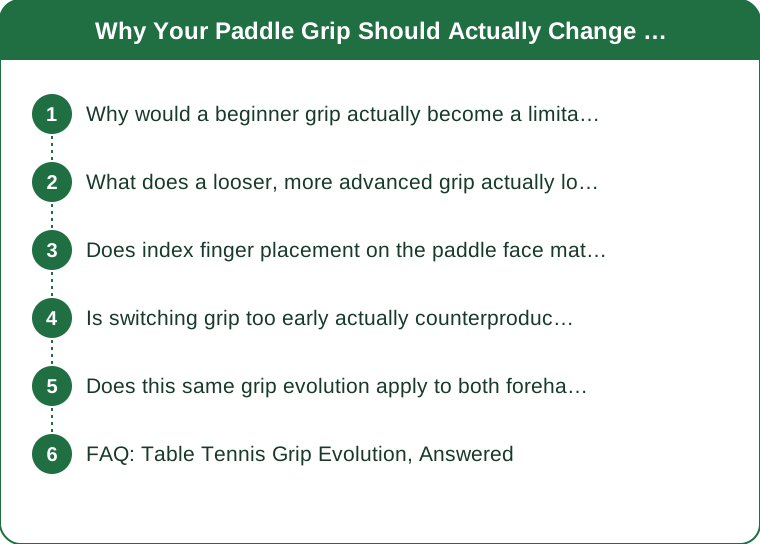
Why would a beginner grip actually become a limitation later on?
A tight, square grip maximizes the flat, stable contact surface a beginner needs to simply make consistent contact with the ball, which is the right priority when control is still developing. But that same tightness restricts the wrist’s range of motion, and wrist snap is exactly what generates topspin and disguised power — so the grip that built your foundation starts working against the next skill layer.
What does a looser, more advanced grip actually look and feel like?
A slightly relaxed grip with a bit more space between the paddle handle and the palm allows the wrist to hinge and snap through contact, rather than the whole forearm moving as one rigid unit. Most coaches describe it as holding the paddle firmly enough that it can’t be knocked loose, but loosely enough that the wrist isn’t locked in place.
Does index finger placement on the paddle face matter as this evolves?
Yes, notably — many improving players shift the index finger slightly further up the paddle’s backside as their shots become more spin-dependent, since a higher finger position gives finer control over paddle angle changes mid-stroke. Beginners often keep the finger lower and more neutral, which favors flat, predictable contact over adjustable spin.

Is switching grip too early actually counterproductive?
It can be — switching to a looser, more spin-oriented grip before basic contact consistency is established often just adds inconsistency on top of inconsistency, since the player loses the stability benefit of the tighter grip before they’ve built the wrist control to compensate. Most coaches recommend the switch only once rallies feel reasonably reliable, not before.
Does this same grip evolution apply to both forehand and backhand equally?
Not entirely — the backhand generally tolerates a slightly firmer grip for longer into a player’s development, since backhand power in the shakehand grip relies more on forearm rotation than wrist snap compared to the forehand. Many players loosen their forehand grip noticeably earlier than their backhand grip as they progress.
FAQ: Table Tennis Grip Evolution, Answered
Is there one ‘correct’ grip tightness for every player at every level?
No — grip tightness is generally described as a spectrum that shifts with skill and even shot type within a single rally, not a single fixed setting everyone should use.
Does paddle weight affect how loose a grip can safely be?
Yes — a heavier paddle generally requires slightly more grip firmness to control safely during fast exchanges, so grip looseness is somewhat paddle-dependent, not just skill-dependent.
Should beginners actively try to loosen their grip early to ‘get ahead’ of the curve?
Most coaches advise against it — building solid contact habits with a firmer grip first, then loosening deliberately once consistency is there, tends to produce better long-term technique than skipping ahead.
TL;DR:
- A tight, square beginner grip maximizes contact confidence but limits wrist snap for spin and power
- A looser, more relaxed grip lets the wrist hinge through contact for topspin and disguised shots
- Index finger placement often shifts higher on the paddle as spin becomes more important
- Backhand grip typically stays firmer longer than forehand grip as players progress
Your grip isn’t supposed to stay the same forever — it’s supposed to evolve alongside your game, and forcing an advanced grip too early usually backfires more than sticking with a beginner grip too long.
Keep Reading
This article is for general informational and styling purposes only. Fit, sizing, and product availability may vary.