How Do You Serve in Table Tennis? A Step-by-Step Breakdown
Quick Answer: A legal table tennis serve requires tossing the ball at least 16 centimeters (about 6 inches) straight up from an open, flat palm, then striking it on the way down behind your own end of the table, making sure the ball is visible to your opponent throughout the toss. Beginners lose the most points not from a weak serve, but from an illegal or inconsistent one.
Most new players focus entirely on adding spin to their serve before they’ve nailed the basic legal mechanics - which is exactly backwards, since an illegal serve gets called out regardless of how much spin it has. Here’s the step-by-step breakdown.

What actually makes a table tennis serve legal?
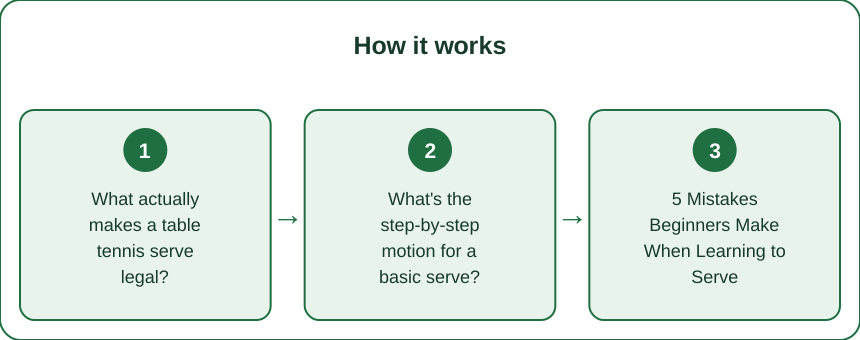
Three rules matter most for beginners: the ball must rest on an open, flat palm before the toss (not held between fingers or thumb), the toss must go up at least 16 centimeters before you strike it, and the ball must stay visible to your opponent throughout the toss and strike - which means you can’t hide the contact behind your body or paddle.
Getting these three right consistently matters more starting out than any spin technique, since a serve that’s called illegal is simply a lost point regardless of how well it was executed otherwise.
A fourth detail worth knowing: the serve must also start with the ball behind the end line of the table (not over the playing surface), and the paddle must stay behind the baseline at contact for singles play - two smaller rules that occasionally trip up players who have otherwise nailed the toss and palm requirements.
What’s the step-by-step motion for a basic serve?
1. Stand with the ball resting flat on your open palm, arm extended over or behind the table’s end line. 2. Toss the ball straight up, at least 16cm, keeping your palm still and letting the ball do the moving. 3. As the ball falls back down, strike it with your paddle at or below table height. 4. Aim your paddle angle and swing direction to place the ball where you intend - toward a specific spot on your opponent’s side, not just anywhere that clears the net.
Practicing this motion slowly, focusing on toss height and contact timing before worrying about spin or placement, builds the consistency that matters most at a beginner level.

5 Mistakes Beginners Make When Learning to Serve
1. Tossing the ball too low. A toss under 16cm is an easy, common call against beginners - exaggerate the height slightly at first until it becomes natural habit.
2. Holding the ball with fingers instead of a flat palm. This is one of the most common serve violations and is often done without the player even realizing it.
3. Rushing the serve before the toss settles. Striking too early, before the ball reaches its full toss height, throws off both legality and control.
4. Serving with no clear target. A serve aimed vaguely at ‘somewhere on the other side’ is easy for an opponent to attack - even beginners benefit from picking a specific target spot before every serve.
5. Trying to add heavy spin before mastering the basic legal motion. Spin is a valuable skill to build later, but layering it onto an inconsistent basic serve usually makes both worse at once.
How does serve placement change your advantage in a point?
Serving short (bouncing twice on your opponent’s side before it would reach the end of the table) makes it harder for an opponent to attack aggressively, since a short ball forces them to reach forward rather than swing freely. Serving deep and fast to a wide corner, by contrast, can rush an opponent’s return but gives them more power to work with if they get to it in time.
Mixing serve placement and depth - rather than serving the same way every time - is one of the simplest ways beginners can start actually winning points directly off the serve instead of just starting the rally evenly.
FAQ: Table Tennis Serve Questions, Answered
Why do my serves keep getting called illegal even though I think they’re fine?
The most common causes are tossing under 16cm or having fingers wrapped slightly around the ball instead of a flat open palm - both are easy to do without noticing until pointed out.
Do I need to add spin to my serve as a beginner?
No - a clean, legal, well-placed flat or light-spin serve is more valuable at a beginner level than an inconsistent heavy-spin serve. Add spin once the basics are consistent.
Can I serve to any part of the table I want?
Yes, as long as the serve is legal and lands on your opponent’s side after crossing the net - varying your placement is a strategy, not a rule restriction.
How many serve variations should I eventually learn?
Most recreational players find 2-3 reliable variations, such as a short backspin serve and a deeper, faster serve, cover most match situations well, rather than needing a huge serve repertoire.
TL;DR:
- A legal serve needs an open palm toss of at least 16cm, struck as the ball falls, staying visible throughout
- Master the basic legal motion before adding spin
- Fingers wrapped around the ball and low tosses are the most common beginner violations
- Varying serve placement and depth wins more points than serving the same way every time
A clean, legal, well-placed serve beats a flashy illegal one every time - literally, since the flashy one just gets called out.
Keep Reading
This article is for general informational and styling purposes only. Fit, sizing, and product availability may vary.